# browser
Interactive Chromium sessions on the [iii engine](https://github.com/iii-hq/iii)
bus. Agents start a session, read the page as an accessibility-tree outline,
click and type against element refs, and read the page's own console and
network history back as data. The single most important thing it gives you:
"why is my dev server page blank?" becomes answerable, because the page's
console errors are one `browser::console::read` away. The [console](https://github.com/iii-hq/workers/tree/main/console)
worker adds the human window: a live Browser page with a streaming viewport
(Chromium-pushed screencast frames), the console feed, and click-to-pick
elements into chat.
It also carries a native Rust scraping surface, `browser::*`: HTTP
and browser fetching, screenshots, persistent sessions and BFS crawling, plus
CSS/XPath/regex queries, element search and HTML→Markdown that run over any
HTML string with no browser at all. See
[Scraping and HTML parsing](#scraping-and-html-parsing-browser) below.
## In the console
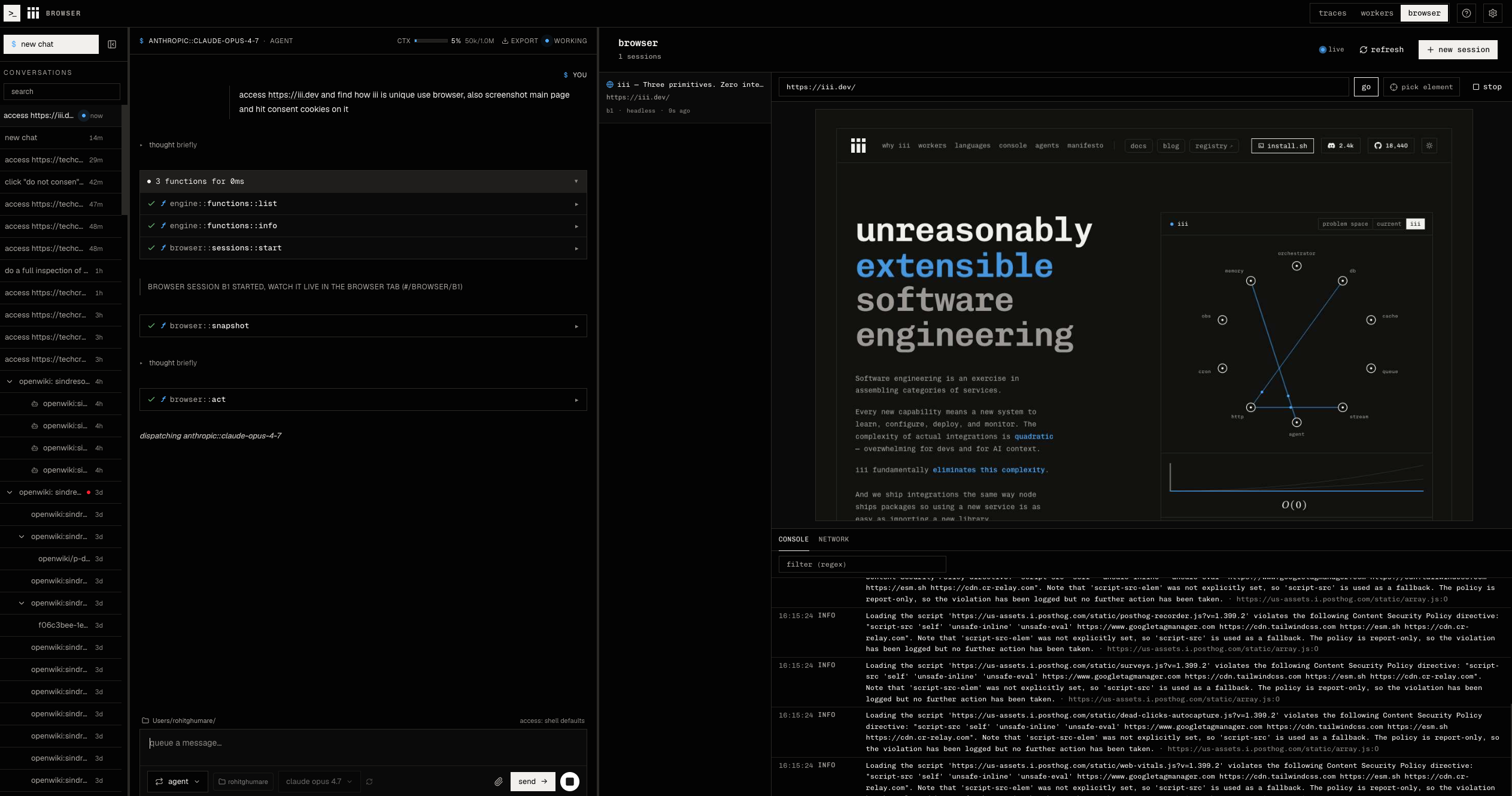
An agent reads a page as an accessibility outline (`browser::snapshot`) while
you watch the live viewport and console feed:
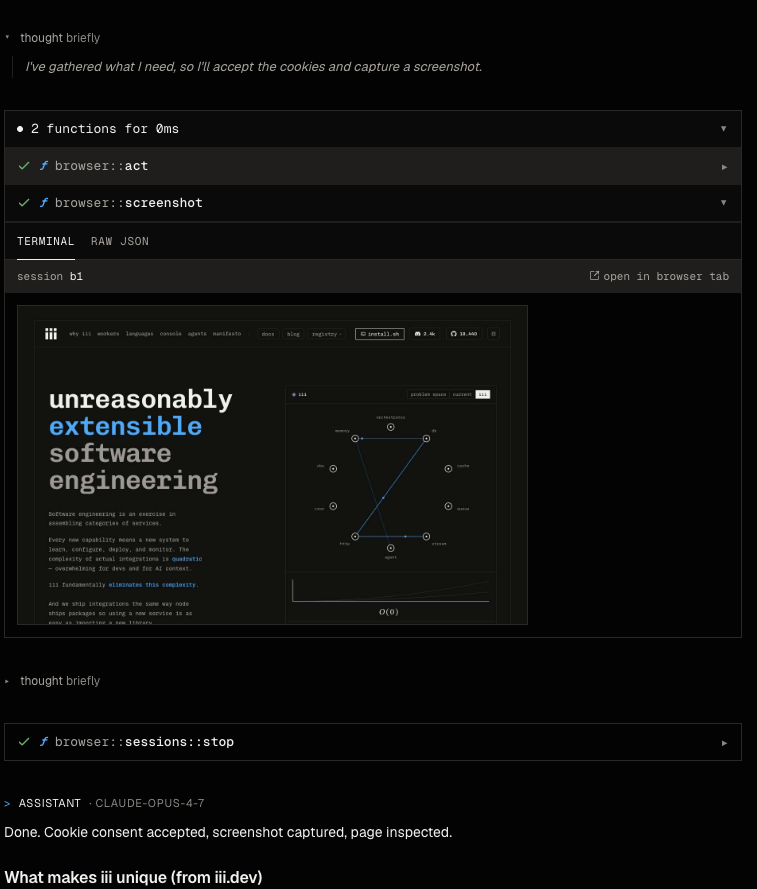
 `browser::screenshot` renders the captured image inline in the chat card:
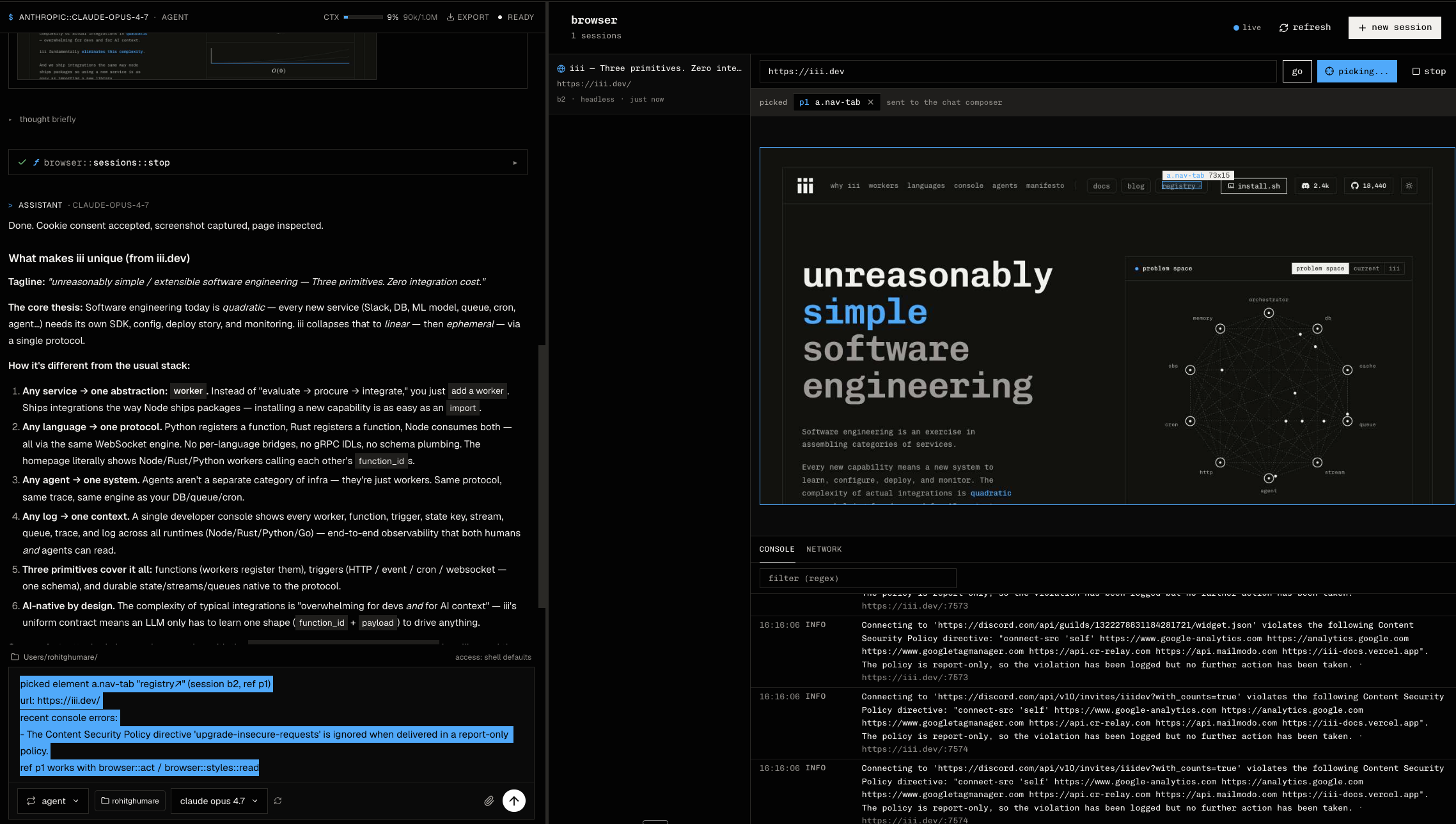
 Pick mode highlights the element under the cursor and drops it into the chat
composer as an actionable ref:
Pick mode highlights the element under the cursor and drops it into the chat
composer as an actionable ref:
 ## Install
```bash
iii worker add browser
```
`iii worker add` fetches the binary, writes a config block into
`~/.iii/config.yaml`, and the engine starts the worker the next time it
boots. The worker drives a Chromium/Chrome already installed on the
machine; point `executable` at a specific binary if auto-detection picks the
wrong one.
To watch sessions live, pick elements into chat, and follow the agent's
browsing from a UI, add the [console](https://github.com/iii-hq/workers/tree/main/console) worker as well:
```bash
iii worker add console
```
## Quickstart
Start a session, read the page, act on it, then read the console:
```rust
use iii_sdk::protocol::TriggerRequest;
use iii_sdk::{register_worker, InitOptions};
use serde_json::json;
#[tokio::main]
async fn main() -> anyhow::Result<()> {
let iii = register_worker("ws://localhost:49134", InitOptions::default());
let started = iii.trigger(TriggerRequest {
function_id: "browser::sessions::start".into(),
payload: json!({ "url": "http://localhost:3000" }),
action: None,
timeout_ms: Some(30_000),
}).await?;
let session_id = started["session_id"].as_str().unwrap();
// The page as text: an a11y outline with [ref=eN] handles.
let snapshot = iii.trigger(TriggerRequest {
function_id: "browser::snapshot".into(),
payload: json!({ "session_id": session_id }),
action: None,
timeout_ms: Some(15_000),
}).await?;
println!("{}", snapshot["tree"].as_str().unwrap());
// What did the page log? Errors only, no dump.
let console = iii.trigger(TriggerRequest {
function_id: "browser::console::read".into(),
payload: json!({ "session_id": session_id, "level": "error" }),
action: None,
timeout_ms: Some(10_000),
}).await?;
println!("{console:#}");
Ok(())
}
```
The rest of the surface: `browser::act` (click/hover/type/press/scroll by
ref or coordinates, left/right/middle and double-click), `browser::evaluate`
(JS expression), `browser::screenshot` (viewable JPEG), `browser::history`
(back/forward/reload), `browser::network::read` (requests + failures),
`browser::dom::read` (DOM tree with refs), `browser::styles::read` /
`browser::styles::write` (computed styles + live inline edits, the design
panel backing), and `browser::sessions::list` / `browser::sessions::stop`.
Function ids and schemas live in the code and `iii worker info browser`.
Beyond single actions: `browser::execute` runs a multi-step async script in
the page — top-level await, `log(...)`, `sleep(ms)`, `waitFor(selector)`, and
a `state` object that persists across execute calls for the session — so one
call replaces a chain of act/evaluate round-trips. `browser::snapshot`
accepts `diff: true` to return only what changed since the previous
snapshot, and reports the document `generation` its refs belong to (ref
names are unique per snapshot and fail closed when stale, never resolving to
a different element). `browser::sessions::start` accepts `read_only: true`
for inspection-only sessions where act/evaluate/execute/styles::write are
rejected. `browser::doctor` reports the environment — detected Chromium,
version, capacity — with an `enable_how` string for anything degraded.
`browser::sessions::attach` binds a session to an already-running browser
over CDP (start Chrome with `--remote-debugging-port`) instead of launching
one, so it reaches the real profile with its logins and extensions. It opens
a fresh tab the session owns, or adopts an existing tab by URL substring and
releases it untouched on stop; `browser::tabs::list` enumerates a running
browser's tabs. Attach reaches logged-in state, so it is off unless
`allow_attach` is set in config, and adoption is exclusive per tab.
`browser::handoff` pauses a session for a step only a human can do (CAPTCHA,
2FA, payment): it mounts an in-page continue banner and blocks the call until
the human clicks it, a `browser::handoff::confirm` call resolves it, or the
timeout elapses, emitting `browser::handoff-requested` for the console to
surface. Human acknowledgment is not proof, so the caller verifies the
expected page state after it returns.
`browser::recording::start` / `browser::recording::stop` capture a session's
live viewport to a webm or mp4 file by piping the screencast through ffmpeg
(turning screencast on if needed); stop returns the path, duration, and
frame count. While screencast is active a human watching the viewport also
sees a ghost cursor following the agent's clicks and a session-status badge;
both are fixed-position in-page overlays that never touch page content.
`browser::doctor` reports whether ffmpeg (recording) and attach mode are
available.
## Scraping and HTML parsing (`browser::*`)
The worker also ships a native Rust port of the [scrapling](https://github.com/D4Vinci/Scrapling)
worker's surface: 19 functions covering HTTP and browser fetching, screenshots,
persistent sessions, crawling, and — the part that needs no browser at all —
parsing HTML you already have.
Start with the parse functions: they work on any HTML string with no browser
or network. Adaptive CSS/XPath/extract calls are the exception to statelessness:
they persist relocation identities in the configured SQLite database. They pair naturally with the session functions above
(navigate, read the page, then parse it), but they don't need one.
```bash
iii trigger browser::css --payload '{
"html": "",
"query": "a.product",
"attr": "href",
"first": true
}'
# → { "result": "/sku/1" }
```
`first` defaults to `false`, in which case `result` is an array of every match
instead of just the first.
```bash
iii trigger browser::extract --payload '{
"html": "",
"selectors": [
{ "name": "title", "css": "h3" },
{ "name": "price", "css": ".price" },
{ "name": "url", "css": "a", "attr": "href" }
]
}'
# → { "extracted": { "title": "Widget", "price": "$19.99", "url": "/sku/1" } }
```
The 10 parse functions: `extract`, `css`, `xpath`, `regex`, `find`,
`find-by-text`, `find-by-regex`, `find-similar`, `describe`, `to-markdown`.
Non-adaptive parsing has no operator-tunable defaults. The fixed limit,
`find` / `find-by-text` / `find-by-regex` capping
at 100 items per call (`limit` clamps to `[0, 100]`), mirrors the python
worker's hardcoded cap.
### Fetching, sessions and crawl
Nine more functions go out to the network. They share one response envelope —
`{status, url, headers, cookies, encoding}` plus, on request, `extracted`
(from `selectors`), `content`+`format` (`markdown`/`text`) and `html` — so the
parse layer above is reachable inline, without a second call.
Three fetch tiers, cheapest first; escalate only when the cheaper one fails:
| | engine | use when |
|---|---|---|
| `fetch` | safe: reqwest/rustls; compat: frozen curl-impersonate | static pages, APIs — no browser, fastest |
| `dynamic-fetch` | frozen Chrome over raw CDP | the page needs JavaScript to render |
| `stealthy-fetch` | frozen Chrome with the Patchright command/launch sequence | the site sniffs for automation |
```bash
iii trigger browser::fetch --json '{
"url": "https://example.com/",
"selectors": [{ "name": "title", "css": "h1" }],
"format": "text"
}'
# → { "status": 200, "url": "...", "extracted": { "title": "Example Domain" }, ... }
```
All three take a single `url` or a bulk `urls` list (bulk returns
`{results: [...]}`, where a failed URL contributes `{url, error}` instead of
sinking the batch). `dynamic-fetch` and `stealthy-fetch` additionally accept
`wait_selector` (+ `wait_selector_state`), `network_idle`, and `wait`.
`browser::screenshot-url` captures a page as image content blocks the console renders
inline — downscaled to 1024px wide and split into at most six 1536px tiles,
with the caption saying so when a page is taller than that.
`session-open` / `session-fetch` / `session-close` / `session-list` keep state
in a private Scrapling registry. HTTP sessions retain one cookie jar/transport;
dynamic and stealthy sessions retain one browser process and context. All use
UUID4 hex ids and serialize requests FIFO per session. They never appear in
`browser::sessions::list`, and interactive ids are not accepted. One-shot
browser calls get a fresh process/profile; retries get a fresh page in that
process. Compat mode supports request proxies, remote `cdp_url`, and
`solve_cloudflare` on stealthy calls.
`crawl` walks links breadth-first from `start_urls`, extracting per page. It
stays on the seed domain by default (`www.` folded), strips URL fragments when
deduping, and stops at `max_pages` (20) or `max_depth` (2). Every page is
emitted on a stream; the RPC response carries only a ≤10-item sample plus the
stream name and group id to read the rest with `stream::on`.
**These functions take a caller-supplied URL, so they are an SSRF surface.**
Safe mode rejects caller proxies and checks every connection against private,
loopback, link-local (including cloud metadata), CGNAT, multicast and reserved
ranges. Set `browser.scrapling.allow_loopback: true` to scrape a local dev
server; every other private range stays blocked. Compat mode intentionally
reproduces the standalone worker's unrestricted network behavior and should be
enabled only for trusted calls. All nine functions remain at the
`needs_approval` default in `iii-permissions.yaml`, unlike the ten parse
functions.
The guarantee differs by tier, and the difference is worth knowing:
- **`fetch` (HTTP) — checked before every hop.** Redirects are followed by
hand precisely so each hop is validated *before* the request is made, and
each connection is pinned to the address that was validated, closing the DNS
rebinding window between check and connect. `Authorization` and `Cookie` are
dropped on a cross-origin redirect, as curl has done since CVE-2018-1000007.
- **Browser tiers — checked at the socket boundary.** Safe-mode Chrome is
forced through an in-process HTTP/CONNECT gate. The gate resolves, checks,
and pins every destination before dialing, including redirect destinations;
direct bypass, QUIC and WebRTC are disabled.
Two more safe-mode limits worth stating: response bodies are bounded at 32 MiB
whether or not the server declares a content length, and a `fetch` call is
capped at three times its `timeout` in total. Compat mode preserves the frozen
worker's unbounded response and retry/redirect quirks.
### Compatibility modes and certification
Request/response schemas are golden-pinned to the frozen Python wrapper apart
from provider-id mapping. Native calls use `browser::`; Python keeps
`scrapling::`. Python `scrapling::screenshot` maps to native
`browser::screenshot-url`, while `browser::screenshot` remains the interactive
session screenshot. Crawl streams default to `browser::crawl`.
`security_mode: safe` is the default. It keeps SSRF checks and resource
ceilings, refuses network options the safe engine cannot enforce, rejects
`verify: false`, and bounds adaptive storage. `security_mode: compat` is only
eligible on Tier-1 Linux x86_64/aarch64 builds produced with the certified
curl-impersonate and Chromium artifacts. Other targets reject compat instead
of silently degrading. Eligibility is not a claim that an arbitrary local
build is certified: builds without the frozen artifacts return a capability
error, and callers should keep using safe mode or the standalone worker.
The parser/query core, CSS-to-XPath translation, XPath 1.0 evaluation, Python
regex behavior, Markdown conversion, selector generation, and adaptive
relocation are repository-owned compatibility implementations covered by
exact differential fixtures. Adaptive queries persist element identities in
SQLite at `adaptive_storage_path`; parse functions remain auto-allowed, so
operators should treat that path as durable worker state. Safe mode enforces
`adaptive_max_bytes` (256 MiB by default) and rolls back a write that would
exceed it. Compat mode keeps the frozen worker's unbounded behavior.
Safe HTTP uses the bounded native engine. Compat HTTP is linked to the frozen
curl-impersonate archive; compat browser calls use the certified Chrome build
through raw pipe/WebSocket CDP and reproduce the frozen Playwright/Patchright
sequences. Persistent browser sessions, proxy rotation, remote CDP,
Cloudflare handling and screenshot transforms use that same private runtime.
Certified builds fail when pinned artifacts are absent or mismatched; there is
no silent fallback from compat to safe.
The standalone worker remains the oracle and production fallback during
rollout. Migrate calls to `browser::` (with screenshot mapped to
`browser::screenshot-url`) only after draining its sessions, then compare both
providers through one stable release and at least 30 days without an
untriaged mismatch. Removing the standalone worker is a separate change.
### Regenerating the parse goldens
`tests/golden/schemas/browser.*.json` and `tests/golden/behavior/**`
are written **only** by `scripts/gen_goldens.py`, run against the reference
Python implementation — never by `UPDATE_GOLDENS=1`, so a passing test always
means "Rust still agrees with Python":
```bash
~/.iii/managed/scrapling/usr/local/bin/python3.12 scripts/gen_goldens.py schemas
~/.iii/managed/scrapling/usr/local/bin/python3.12 scripts/gen_goldens.py behavior
```
## Configuration
Stored in the `configuration` worker under the `browser` key. Existing
interactive-browser settings retain their current behavior. Scrapling settings
live in an isolated nested block: bulk/default policy can be read per call,
while the session cap, idle timeout, and adaptive database path are snapshotted
at worker startup. Restart after changing a startup-snapshotted value.
```yaml
browser:
executable: '' # empty = auto-detect Chrome/Chromium/Edge
user_data_dir: '' # set a path to persist cookies/logins across sessions
headless: true # false shows a real window locally
max_sessions: 4 # concurrent Chromium processes
console_buffer: 500 # per-session console ring buffer (entries)
network_buffer: 500 # per-session network ring buffer (entries)
viewport_width: 1280
viewport_height: 800
default_timeout_ms: 30000 # navigation/act/evaluate default
max_timeout_ms: 120000 # ceiling; caller timeout_ms clamped DOWN to this
idle_stop_ms: 300000 # stop sessions idle this long; 0 disables
screenshot_quality: 60 # JPEG quality 1-100
allowed_schemes: [http, https, file] # `file` lets a local document be rendered; see below
max_snapshot_nodes: 2000 # a11y outline size cap
allow_attach: false # true = allow sessions::attach into a running browser's real profile
scrapling:
security_mode: safe # safe | compat; compat is Tier-1 certified builds only
chromium_executable: '' # certified Chrome path; empty = discovery
allow_loopback: false # true = permit 127.0.0.1 / ::1 in outbound calls
defaults:
impersonate: chrome
headless: true
network_idle: false
proxy: ''
include_html: false
max_bulk_concurrency: 5
max_sessions: 8
session_idle_timeout_s: 900
adaptive_storage_path: ./data/scrapling/elements.db
adaptive_max_bytes: 268435456 # safe only; compat preserves unbounded oracle behavior
```
`file` is on the default scheme list so a local document can be opened and
rendered, which is how `document::ocr` gets pixels out of a scanned PDF. It is
worth knowing what that permits: navigation is not checked against a session's
filesystem scope the way the workers that read files directly are, so anything
that can reach `browser::navigate` can open any file this process can read.
Narrow the list on a shared machine.
The compatibility fields are part of the stable configuration surface.
Non-Tier-1 or artifact-free builds retain safe mode and reject compat
explicitly instead of approximating it.
The declared production envelope is 4 GiB memory and 2 CPUs. Tier-1 release
validation budgets for five concurrent browser processes; that is a release
test envelope, not permission to exceed configured session caps.
## Custom trigger types
Sibling workers (and the console UI) can subscribe to session activity. All
bindings accept an optional `{ "session_id": "..." }` filter.
| Trigger type | Fires when | Payload to subscribers |
|---|---|---|
| `browser::session-started` | A session is up and ready | `{ session_id, url, headless, timestamp }` |
| `browser::session-stopped` | A session ended | `{ session_id, reason: "stopped" \| "idle" \| "crashed", timestamp }` |
| `browser::navigated` | The page committed a navigation | `{ session_id, url, timestamp }` |
| `browser::console-event` | A console/log/exception entry was captured | `{ session_id, entry }` |
| `browser::picked` | The human picked an element in inspect mode | `{ session_id, element, timestamp }` |
| `browser::handoff-requested` | A session paused for a human step (CAPTCHA, 2FA, payment) | `{ session_id, handoff_id, instructions, timestamp }` |
`browser::console-event` is high-volume; bind it with a `session_id` filter
and treat `browser::console::read` as the durable record. `browser::picked`
elements carry a `ref` that `browser::act` accepts directly, so a human pick
flows straight into agent action.
## Element picking
`browser::pick::start` puts the page in DevTools inspect mode (native hover
highlight); the human's click resolves to tag, attributes, outer HTML, text,
bounds, and recent console errors, emitted as `browser::picked`. The pick,
hint, screencast, and frame functions are internal: console-UI plumbing, not
agent surface, and they stay out of agent tool lists.
## Install
```bash
iii worker add browser
```
`iii worker add` fetches the binary, writes a config block into
`~/.iii/config.yaml`, and the engine starts the worker the next time it
boots. The worker drives a Chromium/Chrome already installed on the
machine; point `executable` at a specific binary if auto-detection picks the
wrong one.
To watch sessions live, pick elements into chat, and follow the agent's
browsing from a UI, add the [console](https://github.com/iii-hq/workers/tree/main/console) worker as well:
```bash
iii worker add console
```
## Quickstart
Start a session, read the page, act on it, then read the console:
```rust
use iii_sdk::protocol::TriggerRequest;
use iii_sdk::{register_worker, InitOptions};
use serde_json::json;
#[tokio::main]
async fn main() -> anyhow::Result<()> {
let iii = register_worker("ws://localhost:49134", InitOptions::default());
let started = iii.trigger(TriggerRequest {
function_id: "browser::sessions::start".into(),
payload: json!({ "url": "http://localhost:3000" }),
action: None,
timeout_ms: Some(30_000),
}).await?;
let session_id = started["session_id"].as_str().unwrap();
// The page as text: an a11y outline with [ref=eN] handles.
let snapshot = iii.trigger(TriggerRequest {
function_id: "browser::snapshot".into(),
payload: json!({ "session_id": session_id }),
action: None,
timeout_ms: Some(15_000),
}).await?;
println!("{}", snapshot["tree"].as_str().unwrap());
// What did the page log? Errors only, no dump.
let console = iii.trigger(TriggerRequest {
function_id: "browser::console::read".into(),
payload: json!({ "session_id": session_id, "level": "error" }),
action: None,
timeout_ms: Some(10_000),
}).await?;
println!("{console:#}");
Ok(())
}
```
The rest of the surface: `browser::act` (click/hover/type/press/scroll by
ref or coordinates, left/right/middle and double-click), `browser::evaluate`
(JS expression), `browser::screenshot` (viewable JPEG), `browser::history`
(back/forward/reload), `browser::network::read` (requests + failures),
`browser::dom::read` (DOM tree with refs), `browser::styles::read` /
`browser::styles::write` (computed styles + live inline edits, the design
panel backing), and `browser::sessions::list` / `browser::sessions::stop`.
Function ids and schemas live in the code and `iii worker info browser`.
Beyond single actions: `browser::execute` runs a multi-step async script in
the page — top-level await, `log(...)`, `sleep(ms)`, `waitFor(selector)`, and
a `state` object that persists across execute calls for the session — so one
call replaces a chain of act/evaluate round-trips. `browser::snapshot`
accepts `diff: true` to return only what changed since the previous
snapshot, and reports the document `generation` its refs belong to (ref
names are unique per snapshot and fail closed when stale, never resolving to
a different element). `browser::sessions::start` accepts `read_only: true`
for inspection-only sessions where act/evaluate/execute/styles::write are
rejected. `browser::doctor` reports the environment — detected Chromium,
version, capacity — with an `enable_how` string for anything degraded.
`browser::sessions::attach` binds a session to an already-running browser
over CDP (start Chrome with `--remote-debugging-port`) instead of launching
one, so it reaches the real profile with its logins and extensions. It opens
a fresh tab the session owns, or adopts an existing tab by URL substring and
releases it untouched on stop; `browser::tabs::list` enumerates a running
browser's tabs. Attach reaches logged-in state, so it is off unless
`allow_attach` is set in config, and adoption is exclusive per tab.
`browser::handoff` pauses a session for a step only a human can do (CAPTCHA,
2FA, payment): it mounts an in-page continue banner and blocks the call until
the human clicks it, a `browser::handoff::confirm` call resolves it, or the
timeout elapses, emitting `browser::handoff-requested` for the console to
surface. Human acknowledgment is not proof, so the caller verifies the
expected page state after it returns.
`browser::recording::start` / `browser::recording::stop` capture a session's
live viewport to a webm or mp4 file by piping the screencast through ffmpeg
(turning screencast on if needed); stop returns the path, duration, and
frame count. While screencast is active a human watching the viewport also
sees a ghost cursor following the agent's clicks and a session-status badge;
both are fixed-position in-page overlays that never touch page content.
`browser::doctor` reports whether ffmpeg (recording) and attach mode are
available.
## Scraping and HTML parsing (`browser::*`)
The worker also ships a native Rust port of the [scrapling](https://github.com/D4Vinci/Scrapling)
worker's surface: 19 functions covering HTTP and browser fetching, screenshots,
persistent sessions, crawling, and — the part that needs no browser at all —
parsing HTML you already have.
Start with the parse functions: they work on any HTML string with no browser
or network. Adaptive CSS/XPath/extract calls are the exception to statelessness:
they persist relocation identities in the configured SQLite database. They pair naturally with the session functions above
(navigate, read the page, then parse it), but they don't need one.
```bash
iii trigger browser::css --payload '{
"html": "",
"query": "a.product",
"attr": "href",
"first": true
}'
# → { "result": "/sku/1" }
```
`first` defaults to `false`, in which case `result` is an array of every match
instead of just the first.
```bash
iii trigger browser::extract --payload '{
"html": "",
"selectors": [
{ "name": "title", "css": "h3" },
{ "name": "price", "css": ".price" },
{ "name": "url", "css": "a", "attr": "href" }
]
}'
# → { "extracted": { "title": "Widget", "price": "$19.99", "url": "/sku/1" } }
```
The 10 parse functions: `extract`, `css`, `xpath`, `regex`, `find`,
`find-by-text`, `find-by-regex`, `find-similar`, `describe`, `to-markdown`.
Non-adaptive parsing has no operator-tunable defaults. The fixed limit,
`find` / `find-by-text` / `find-by-regex` capping
at 100 items per call (`limit` clamps to `[0, 100]`), mirrors the python
worker's hardcoded cap.
### Fetching, sessions and crawl
Nine more functions go out to the network. They share one response envelope —
`{status, url, headers, cookies, encoding}` plus, on request, `extracted`
(from `selectors`), `content`+`format` (`markdown`/`text`) and `html` — so the
parse layer above is reachable inline, without a second call.
Three fetch tiers, cheapest first; escalate only when the cheaper one fails:
| | engine | use when |
|---|---|---|
| `fetch` | safe: reqwest/rustls; compat: frozen curl-impersonate | static pages, APIs — no browser, fastest |
| `dynamic-fetch` | frozen Chrome over raw CDP | the page needs JavaScript to render |
| `stealthy-fetch` | frozen Chrome with the Patchright command/launch sequence | the site sniffs for automation |
```bash
iii trigger browser::fetch --json '{
"url": "https://example.com/",
"selectors": [{ "name": "title", "css": "h1" }],
"format": "text"
}'
# → { "status": 200, "url": "...", "extracted": { "title": "Example Domain" }, ... }
```
All three take a single `url` or a bulk `urls` list (bulk returns
`{results: [...]}`, where a failed URL contributes `{url, error}` instead of
sinking the batch). `dynamic-fetch` and `stealthy-fetch` additionally accept
`wait_selector` (+ `wait_selector_state`), `network_idle`, and `wait`.
`browser::screenshot-url` captures a page as image content blocks the console renders
inline — downscaled to 1024px wide and split into at most six 1536px tiles,
with the caption saying so when a page is taller than that.
`session-open` / `session-fetch` / `session-close` / `session-list` keep state
in a private Scrapling registry. HTTP sessions retain one cookie jar/transport;
dynamic and stealthy sessions retain one browser process and context. All use
UUID4 hex ids and serialize requests FIFO per session. They never appear in
`browser::sessions::list`, and interactive ids are not accepted. One-shot
browser calls get a fresh process/profile; retries get a fresh page in that
process. Compat mode supports request proxies, remote `cdp_url`, and
`solve_cloudflare` on stealthy calls.
`crawl` walks links breadth-first from `start_urls`, extracting per page. It
stays on the seed domain by default (`www.` folded), strips URL fragments when
deduping, and stops at `max_pages` (20) or `max_depth` (2). Every page is
emitted on a stream; the RPC response carries only a ≤10-item sample plus the
stream name and group id to read the rest with `stream::on`.
**These functions take a caller-supplied URL, so they are an SSRF surface.**
Safe mode rejects caller proxies and checks every connection against private,
loopback, link-local (including cloud metadata), CGNAT, multicast and reserved
ranges. Set `browser.scrapling.allow_loopback: true` to scrape a local dev
server; every other private range stays blocked. Compat mode intentionally
reproduces the standalone worker's unrestricted network behavior and should be
enabled only for trusted calls. All nine functions remain at the
`needs_approval` default in `iii-permissions.yaml`, unlike the ten parse
functions.
The guarantee differs by tier, and the difference is worth knowing:
- **`fetch` (HTTP) — checked before every hop.** Redirects are followed by
hand precisely so each hop is validated *before* the request is made, and
each connection is pinned to the address that was validated, closing the DNS
rebinding window between check and connect. `Authorization` and `Cookie` are
dropped on a cross-origin redirect, as curl has done since CVE-2018-1000007.
- **Browser tiers — checked at the socket boundary.** Safe-mode Chrome is
forced through an in-process HTTP/CONNECT gate. The gate resolves, checks,
and pins every destination before dialing, including redirect destinations;
direct bypass, QUIC and WebRTC are disabled.
Two more safe-mode limits worth stating: response bodies are bounded at 32 MiB
whether or not the server declares a content length, and a `fetch` call is
capped at three times its `timeout` in total. Compat mode preserves the frozen
worker's unbounded response and retry/redirect quirks.
### Compatibility modes and certification
Request/response schemas are golden-pinned to the frozen Python wrapper apart
from provider-id mapping. Native calls use `browser::`; Python keeps
`scrapling::`. Python `scrapling::screenshot` maps to native
`browser::screenshot-url`, while `browser::screenshot` remains the interactive
session screenshot. Crawl streams default to `browser::crawl`.
`security_mode: safe` is the default. It keeps SSRF checks and resource
ceilings, refuses network options the safe engine cannot enforce, rejects
`verify: false`, and bounds adaptive storage. `security_mode: compat` is only
eligible on Tier-1 Linux x86_64/aarch64 builds produced with the certified
curl-impersonate and Chromium artifacts. Other targets reject compat instead
of silently degrading. Eligibility is not a claim that an arbitrary local
build is certified: builds without the frozen artifacts return a capability
error, and callers should keep using safe mode or the standalone worker.
The parser/query core, CSS-to-XPath translation, XPath 1.0 evaluation, Python
regex behavior, Markdown conversion, selector generation, and adaptive
relocation are repository-owned compatibility implementations covered by
exact differential fixtures. Adaptive queries persist element identities in
SQLite at `adaptive_storage_path`; parse functions remain auto-allowed, so
operators should treat that path as durable worker state. Safe mode enforces
`adaptive_max_bytes` (256 MiB by default) and rolls back a write that would
exceed it. Compat mode keeps the frozen worker's unbounded behavior.
Safe HTTP uses the bounded native engine. Compat HTTP is linked to the frozen
curl-impersonate archive; compat browser calls use the certified Chrome build
through raw pipe/WebSocket CDP and reproduce the frozen Playwright/Patchright
sequences. Persistent browser sessions, proxy rotation, remote CDP,
Cloudflare handling and screenshot transforms use that same private runtime.
Certified builds fail when pinned artifacts are absent or mismatched; there is
no silent fallback from compat to safe.
The standalone worker remains the oracle and production fallback during
rollout. Migrate calls to `browser::` (with screenshot mapped to
`browser::screenshot-url`) only after draining its sessions, then compare both
providers through one stable release and at least 30 days without an
untriaged mismatch. Removing the standalone worker is a separate change.
### Regenerating the parse goldens
`tests/golden/schemas/browser.*.json` and `tests/golden/behavior/**`
are written **only** by `scripts/gen_goldens.py`, run against the reference
Python implementation — never by `UPDATE_GOLDENS=1`, so a passing test always
means "Rust still agrees with Python":
```bash
~/.iii/managed/scrapling/usr/local/bin/python3.12 scripts/gen_goldens.py schemas
~/.iii/managed/scrapling/usr/local/bin/python3.12 scripts/gen_goldens.py behavior
```
## Configuration
Stored in the `configuration` worker under the `browser` key. Existing
interactive-browser settings retain their current behavior. Scrapling settings
live in an isolated nested block: bulk/default policy can be read per call,
while the session cap, idle timeout, and adaptive database path are snapshotted
at worker startup. Restart after changing a startup-snapshotted value.
```yaml
browser:
executable: '' # empty = auto-detect Chrome/Chromium/Edge
user_data_dir: '' # set a path to persist cookies/logins across sessions
headless: true # false shows a real window locally
max_sessions: 4 # concurrent Chromium processes
console_buffer: 500 # per-session console ring buffer (entries)
network_buffer: 500 # per-session network ring buffer (entries)
viewport_width: 1280
viewport_height: 800
default_timeout_ms: 30000 # navigation/act/evaluate default
max_timeout_ms: 120000 # ceiling; caller timeout_ms clamped DOWN to this
idle_stop_ms: 300000 # stop sessions idle this long; 0 disables
screenshot_quality: 60 # JPEG quality 1-100
allowed_schemes: [http, https, file] # `file` lets a local document be rendered; see below
max_snapshot_nodes: 2000 # a11y outline size cap
allow_attach: false # true = allow sessions::attach into a running browser's real profile
scrapling:
security_mode: safe # safe | compat; compat is Tier-1 certified builds only
chromium_executable: '' # certified Chrome path; empty = discovery
allow_loopback: false # true = permit 127.0.0.1 / ::1 in outbound calls
defaults:
impersonate: chrome
headless: true
network_idle: false
proxy: ''
include_html: false
max_bulk_concurrency: 5
max_sessions: 8
session_idle_timeout_s: 900
adaptive_storage_path: ./data/scrapling/elements.db
adaptive_max_bytes: 268435456 # safe only; compat preserves unbounded oracle behavior
```
`file` is on the default scheme list so a local document can be opened and
rendered, which is how `document::ocr` gets pixels out of a scanned PDF. It is
worth knowing what that permits: navigation is not checked against a session's
filesystem scope the way the workers that read files directly are, so anything
that can reach `browser::navigate` can open any file this process can read.
Narrow the list on a shared machine.
The compatibility fields are part of the stable configuration surface.
Non-Tier-1 or artifact-free builds retain safe mode and reject compat
explicitly instead of approximating it.
The declared production envelope is 4 GiB memory and 2 CPUs. Tier-1 release
validation budgets for five concurrent browser processes; that is a release
test envelope, not permission to exceed configured session caps.
## Custom trigger types
Sibling workers (and the console UI) can subscribe to session activity. All
bindings accept an optional `{ "session_id": "..." }` filter.
| Trigger type | Fires when | Payload to subscribers |
|---|---|---|
| `browser::session-started` | A session is up and ready | `{ session_id, url, headless, timestamp }` |
| `browser::session-stopped` | A session ended | `{ session_id, reason: "stopped" \| "idle" \| "crashed", timestamp }` |
| `browser::navigated` | The page committed a navigation | `{ session_id, url, timestamp }` |
| `browser::console-event` | A console/log/exception entry was captured | `{ session_id, entry }` |
| `browser::picked` | The human picked an element in inspect mode | `{ session_id, element, timestamp }` |
| `browser::handoff-requested` | A session paused for a human step (CAPTCHA, 2FA, payment) | `{ session_id, handoff_id, instructions, timestamp }` |
`browser::console-event` is high-volume; bind it with a `session_id` filter
and treat `browser::console::read` as the durable record. `browser::picked`
elements carry a `ref` that `browser::act` accepts directly, so a human pick
flows straight into agent action.
## Element picking
`browser::pick::start` puts the page in DevTools inspect mode (native hover
highlight); the human's click resolves to tag, attributes, outer HTML, text,
bounds, and recent console errors, emitted as `browser::picked`. The pick,
hint, screencast, and frame functions are internal: console-UI plumbing, not
agent surface, and they stay out of agent tool lists.