# editor
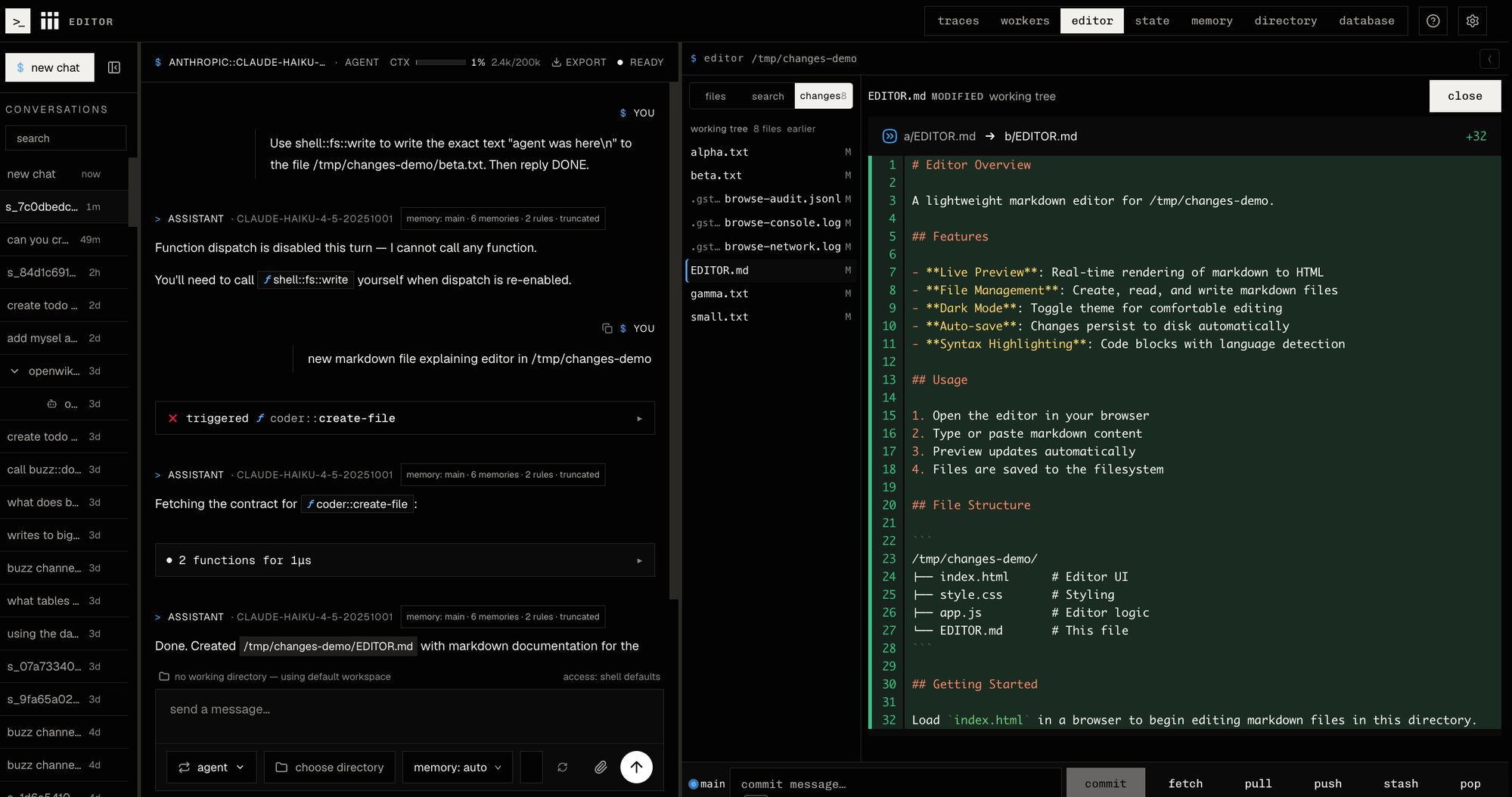
A code workspace that an agent and a person share. Open a folder, and the
buffers you have open, the folders you have expanded, and the version each
buffer was read at are one record on the bus — so the file an agent opens
appears in your tabs, and the file you open is one the agent can see.
The unit is a **folder**, not a repository. The tree, the tabs, the editor and
the finder all work in a plain directory; git adds a branch label and change
marks when the root happens to be a repo, and nothing else changes when it
is not.
When an agent is working, its edits land in the **changes** tab as they
happen: one group per turn with the files it touched and the lines it moved,
and the diff of any one of them a click away. Nothing is polled — the worker
observes every filesystem call the agent makes and pushes an `editor::changed`
event, so a write made by anything shows up, including tools that never call
this worker.
It opens no files itself. Reads, writes, moves, listings and `git` all go
through the [`shell`](https://github.com/iii-hq/workers/tree/main/shell) worker,
so shell's jail and denylist are the only filesystem boundary; the workspace
record lives in [`state`](https://github.com/iii-hq/workers/tree/main/state).
What `editor` adds is the model on top: diffing, ranking paths, refusing a
stale write, and keeping open buffers correct when a folder moves under them.
## Install
```bash
iii worker add editor
iii worker add shell # required — editor has no filesystem access of its own
iii worker add state # required — the workspace record lives here
```
### Companion workers
| Worker | Why |
|---|---|
| [`shell`](https://github.com/iii-hq/workers/tree/main/shell) | Required. Every read, write, move, listing (`coder::tree`) and `git` invocation. Its `fs.host_roots` jail governs which paths `editor` can reach. |
| [`state`](https://github.com/iii-hq/workers/tree/main/state) | Required. Holds the active root and one session per project (open buffers, expanded folders). |
| [`console`](https://github.com/iii-hq/workers/tree/main/console) | Optional. Renders the `#/ext/editor` page and the `editor::*` chat cards. |
## Quickstart
```rust
use iii_sdk::protocol::TriggerRequest;
use iii_sdk::{register_worker, InitOptions};
use serde_json::json;
#[tokio::main]
async fn main() -> anyhow::Result<()> {
let iii = register_worker("ws://localhost:49134", InitOptions::default());
let call = |id: &str, payload| iii.trigger(TriggerRequest {
function_id: id.into(), payload, action: None, timeout_ms: Some(30_000),
});
// Any folder. No repository required.
call("editor::workspace::open", json!({ "root": "/srv/app" })).await?;
let file = call("editor::open", json!({ "path": "src/main.rs" })).await?;
let edited = file["content"].as_str().unwrap().replace("TODO", "done");
// Show the change before making it.
let preview = call("editor::diff", json!({
"before": file["content"], "after": edited, "path": "src/main.rs",
})).await?;
println!("{}", preview["patch"].as_str().unwrap());
// The version from the open is what makes this safe: if anything else
// touched the file in between, nothing is written and the divergence
// comes back as a patch. `expected_mtime` also works and is still
// honoured, but it cannot see a write that landed inside the same second.
let saved = call("editor::save", json!({
"path": "src/main.rs", "content": edited, "expected_version": file["version"],
})).await?;
if saved["conflict"] == true {
println!("refused:\n{}", saved["conflict_patch"].as_str().unwrap());
}
Ok(())
}
```
## Functions
| Function | Does |
|---|---|
| `editor::workspace::open` | Point the workspace at a folder. Returns the buffers and expanded folders remembered for it. |
| `editor::workspace::get` | The active root, open buffers, and expanded folders — what every surface sees. |
| `editor::tree` | List a folder, with the workspace's expansion state. The walk, the noise-folder excludes and the jail are shell's. |
| `editor::open` | Read a text file and record it as an open buffer, with its language id and the content version to save against. |
| `editor::save` | Whole-file write, refused when the file changed since the open it started from. The refusal carries the disk-vs-yours diff. |
| `editor::buffers::list` | Files currently open. |
| `editor::buffers::close` | Close one buffer. The file on disk is untouched. |
| `editor::move` | Move or rename, then rewrite every open buffer and expanded folder at or under the path. |
| `editor::create` | Create a file or folder, parents included. A file may be seeded with content. |
| `editor::delete` | Remove a path and close any buffer it held. |
| `editor::find` | Fuzzy file finder, ranked basename-first. Candidates from git in a repo, from the folder listing otherwise. |
| `editor::search` | Search file contents across the workspace, grouped by file. shell's recursive grep, shaped for a results panel. |
| `editor::diff` | Unified patch between two texts. Pure — no path is read, so it works on content that is not on disk yet. |
| `editor::git::status` | Branch, upstream, ahead/behind, and one typed row per changed path. |
| `editor::git::hunks` | What changed in one file: the rendered patch plus its line ranges. |
| `editor::git::show` | A file's contents at a revision, HEAD by default. Pair it with the working copy to render a diff without parsing a patch. |
| `editor::git::commit` | Stage and commit. `committed: false` when there was nothing staged. |
| `editor::git::sync` | Fetch, fast-forward pull, or push, with ahead/behind after. |
| `editor::git::stash` | Stash the working tree, or pop the most recent stash. |
| `editor::git::undo-commit` | `reset --soft HEAD~1`, returning the SHA and message undone. |
Pull is `--ff-only` on purpose: a merge under open buffers is how an editor
ends up showing a conflicted tree nobody asked for. A repository that needs
interactive credentials will hit `git_timeout_ms` rather than hang, because
`shell::exec` owns the process.
Two are worth calling out. `editor::diff` is the one an agent reaches for most:
it can show exactly what a write will change before making it. And `editor::move`
exists because `shell::fs::mv` alone leaves open buffers pointing at the old
path — the next save then writes them back there, silently recreating the folder
that was just moved.
## Custom trigger types
| Trigger type | Fires when | Payload |
|---|---|---|
| `editor::changed` | A file in the workspace changed, whoever changed it | `path`, `cause` (the function id that did it), `kind` (`created` \| `modified` \| `deleted` \| `unknown`), `added`, `removed`, `patch`, `truncated`, `root` |
The event is how a surface follows an agent without polling. It does not
require the agent to cooperate: the worker binds a `harness::hook::post-trigger`
hook on the `shell::*` and `coder::*` write paths, so an edit made by anything
becomes an event. The hook is advisory and fail-open — it never delays or
denies the write that produced it.
```rust
use iii_sdk::protocol::RegisterTriggerInput;
iii.register_trigger(RegisterTriggerInput {
trigger_type: "editor::changed".to_string(),
function_id: "my-worker::on-edit".to_string(),
config: serde_json::json!({}),
metadata: None,
})?;
```
Bindings take no config. Delivery is fire-and-forget: a slow or absent
subscriber is logged and skipped. `patch` is capped at 16 KiB with `truncated`
set — ask `editor::git::hunks` when you need the whole thing.
## Console page
`#/ext/editor` is a view over the same workspace: a collapsible file tree on
the left with a files/search switch, tabs on the right, and a save that
surfaces the conflict guard as a dialog. The open file has its own view strip
— `read`, `edit`, `preview` on a markdown file, `unsaved` while there is
something unsaved, and `head` for the diff against the last commit. A status
line under it carries the path, language, line count, git deltas, saved state
and the most recent observed edit. A git strip along the bottom does commit,
fetch, pull, push, stash and pop. Folder expansion round-trips through the
worker, so it survives a reload and both surfaces agree on it.
Nothing is polled: one read on mount seeds the git overlay, and after that the
page reacts to `editor::changed` and to the workspace's own `state` scope. So a
file an agent edits lights up as the edit lands and an open tab you have not
typed in reloads under you. A tab you *have* edited is never reloaded; it is
flagged, and the conflict guard decides the outcome.
`editor::*` calls also render as themselves in chat and traces: a diff as a
diff, a save as a file card with its line counts.
Files and diffs are drawn with [`@pierre/diffs`](https://www.npmjs.com/package/@pierre/diffs)
— real line numbers, a syntax theme, and its own add/delete colouring, all
inside its own shadow root. `editor::diff` and `editor::git::hunks` already
return unified patch text, which is exactly what it parses. Editing stays on
the console's shared Monaco `CodeEditor`: it is the one editing surface, and
the SOP forbids bundling a second editor to get chrome back. Bundling
`@pierre/diffs` as-is costs 10.3 MB — over the console's 8 MiB per-asset cap,
and almost all of it shiki's full grammar and theme catalogs — so `ui/build.mjs`
narrows those catalogs to what this worker opens and asserts both the size
budget and that highlighting still works.
## Configuration
Runtime config lives in the `configuration` worker under id `editor`, so the
console's Workers tab can edit it and every field hot-reloads — handlers read
the live snapshot per call, and nothing needs a restart. The block below is what
gets seeded when nothing is stored yet, and `--config ` takes a file in
that shape as an optional one-time seed that never overwrites a stored value.
The committed `config.yaml` is *not* that file: it is a bare engine config
(`workers: []`) for running this worker from source, and it would be rejected as
a worker seed.
If the configuration worker cannot be reached at boot, the worker retries, then
starts on the `--config` seed rather than exiting — with a warning naming which
numbers are in force — and keeps asking in the background until the
authoritative value lands. The built-in defaults are used only when nothing was
seeded either.
Every field is a bound. Nothing here grants access — that is `shell`'s config.
```yaml
max_diff_bytes: 2000000 # per side of editor::diff, bytes
diff_context_lines: 3 # editor::diff's default context; hunks defaults to 0
find_limit: 50 # rows returned by editor::find
max_find_candidates: 50000 # paths scanned per editor::find call
max_file_bytes: 2000000 # largest file editor::open will pull back
search_max_matches: 2000 # matching lines editor::search collects
git_timeout_ms: 15000 # per git invocation handed to shell::exec
```
## Local development & testing
```bash
iii -c config.yaml # a bare engine (workers: []) so this worker runs from source
cargo run --release -- --url ws://127.0.0.1:49134
cargo test
```
`--url` also reads `III_URL`, which the worker manager injects — inside a
sandbox the engine is on the VM's gateway, never on its loopback.
The console assets are built from `ui/` by `build.rs`. For the hot-reload loop:
```bash
cd ui && pnpm install && pnpm watch # esbuild --watch → dist/
III_EDITOR_UI_WATCH=1 cargo run # re-registers each changed asset
```